
- October 16, 2026
- Startup Portal
- 0 Comments
- Blogs
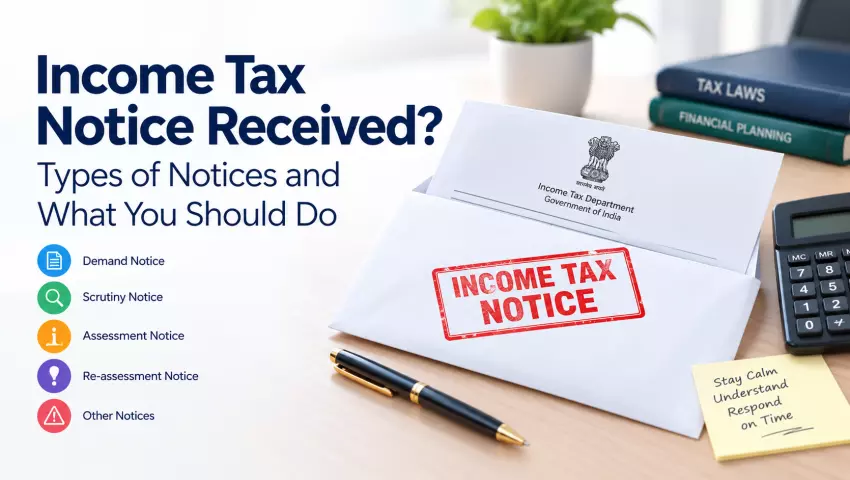
Income Tax Notice Received? Types of Notices and What You Should Do
Income tax notice received and your heart skipped a beat? Take a breath first. Not every IT notice means trouble. A large number of these are routine, system-generated communications that go out automatically after your return is processed. This guide walks you through what the different notice sections mean, how to verify an ITR notice is genuine, your response deadlines, and when it’s time to bring in professional help.
This guide is brought to you by Startup Portal business services, your go-to partner for company registration in Pune and ongoing tax compliance, with insights from our compliance experts Nikhil Rajarshi and Govind S. Jethani. They bring 8+ years of experience helping business owners navigate exactly this kind of process, including responding to income tax notices without the panic.
Verify the Notice Is Genuine Before You Do Anything:
Before you react to any it notice, confirm it actually came from the Income Tax Department. Every valid income tax notice carries a Document Identification Number (DIN) — this is non-negotiable proof of authenticity.
Here’s how to check it:
- Log in to the income tax e-filing portal
- Go to Pending Actions → e-Proceedings
- Confirm the notice appears against your PAN
- Use the “Authenticate notice/order issued by ITD” service under Quick Links to verify the DIN independently
Red flags of fake or phishing notices:
- No DIN mentioned anywhere on the document
- Emails from suspicious or non-government domains
- Urgent payment demands routed through unofficial payment links instead of the official portal
If a so-called notice of income tax doesn’t carry a verifiable DIN, don’t act on it — don’t click links, don’t make payments, and don’t share personal details.
A Quick Note on the Law That Applies to Your Notice:
Here’s something a lot of guides miss: which law applies to your notice depends on the year involved.
- For FY 2025-26 (AY 2026-27) and earlier years, notices still reference the Income-tax Act, 1961
- From Tax Year 2026-27 onward, the new Income Tax Act, 2025 applies — with renumbered sections and updated terminology
This matters practically: don’t assume the section number you read in an older article (or even in this guide) automatically matches your notice. Always check the exact section quoted on your specific notice before deciding how to respond — the number tells you why the notice was issued and what’s expected of you.
Common Types of Income Tax Notices, Decoded:
Let’s go through the income tax notices reasons you’re most likely to encounter, one by one.
1. Intimation under Section 143(1) — "Your Return Has Been Processed"
This is usually the first communication most taxpayers receive after filing. It’s generated when the Central Processing Centre (CPC) compares your filed return against the department’s own records.
Three possible outcomes:
- Your return is accepted as filed — no action needed
- A refund is due to you
- A demand is raised because of an adjustment — commonly a TDS mismatch or an arithmetic error
2. Defective Return Notice under Section 139(9):
This ITR notice means something in your return didn’t pass basic validation. Common reasons include:
- Using the wrong ITR form for your income type
- Leaving required schedules blank
- Reporting inconsistent income figures across sections
- Missing an audit report where one was required
3. Inquiry Notice under Section 142(1):
This one is issued either to non-filers who should have filed a return, or to request specific documents — books of account, deduction proofs, or other records — before an assessment proceeds.
4. Scrutiny Notice under Section 143(2):
Getting selected for scrutiny sounds alarming, but it isn’t automatically adversarial. It simply means the Assessing Officer wants to examine your return and supporting documents more closely before finalizing the assessment.
5. Reassessment Notice under Section 148 (preceded by 148A):
This is issued when the department believes some of your taxable income “escaped” assessment in an earlier year. The reassessment window is generally up to 3 years from the end of the relevant assessment year, extending to 5 years where the escaped income is ₹50 lakh or more.
6. Refund Adjustment Notice under Section 245:
This tells you that a refund you were expecting has instead been adjusted against an outstanding demand from a previous year.
7. Demand Notice under Section 156:
This is issued after an assessment, reassessment, or rectification determines that tax, interest, penalty, or a fee is payable — essentially, the final bill.
Response Deadlines at a Glance:
These are typical timeframes — but the one thing to remember is that the deadline printed on your actual notice always overrides any general guide. Missing your stated deadline is worse than missing a “typical” one, because extensions and consequences are tied to what’s specifically written on your document.
How to Actually Respond on the Income Tax Portal?
- Log in to the income tax e-filing portal and open Pending Actions → e-Proceedings
- Read the notice carefully — note the section, DIN, reason, and response deadline
- Verify the DIN if you haven’t already
- Upload the requested documents, or agree-and-pay, or disagree with supporting documents — whichever applies
- Submit your response and save the acknowledgment for your records
- Request an extension before the deadline, not after — extensions requested late are far less likely to be granted
What Happens If You Ignore a Notice?
Ignoring an it notice rarely makes it go away — it usually escalates:
- Section 139(9): your return can be treated as invalid if the defect isn’t corrected in time
- Section 245: your refund gets silently adjusted against the outstanding demand
- Sections 142(1)/143(2): non-response can lead to a best judgment assessment under Section 144, where the officer decides your tax liability without your input
- Section 272A(1)(d): a flat penalty applies for failing to comply with certain notices
- Section 156: unpaid demands attract interest and can trigger recovery proceedings
What Usually Triggers a Notice in the First Place?
Understanding the common income tax notices reasons helps you avoid them next year:
- Mismatches between your return and your AIS or Form 26AS
- Filing the wrong ITR form or leaving schedules incomplete
- Claiming deductions or exemptions without supporting documentation
- High-value transactions flagged by banks or financial institutions
- Simply not filing a return despite having taxable income
Rectification vs. Response vs. Appeal — Know the Difference:
These three terms get mixed up often, but they’re distinct paths:
- Rectification (Section 154): used for apparent, clerical mistakes in an intimation — like a calculation error the department itself made
- Response via e-Proceedings: used when you disagree with an adjustment or want to submit clarifying documents
- Appeal: used when you disagree with a final assessment or demand order and want it formally reviewed by an appellate authority
Choosing the right path saves time and avoids unnecessary back-and-forth with the department.
When You Should Bring In a Professional?
Not every ITR notice needs a CA. Straightforward ones — like a Section 143(1) intimation confirming your return, or a Section 139(9) defective return notice with an obvious fix — can often be handled yourself directly through the portal.
But scrutiny notices (143(2)), reassessment notices (148), or anything involving a substantial demand are a different story. Getting your response wrong here can cost far more than a professional consultation would have. If you’re based in Pune and want expert eyes on your notice before you respond, Startup Portal’s ITR E-Filing in Pune service can review your documents and help you draft an accurate, timely response.
Conclusion:
Getting a notice isn’t the end of the world — but getting the response wrong, or missing the deadline, can turn a routine communication into a real problem. If you’d like expert help drafting your response before the deadline (not after it’s escalated), Startup Portal’s team — led by Nikhil Rajarshi and Govind S. Jethani — can guide you through it. And if you’re looking to set up a proper business structure going forward so your compliance stays organised from day one, our Company Registration in Pune service can help you get started the right way.
Received an Income Tax Notice? Don’t Face It Alone.
Whether it’s a routine intimation or a scrutiny notice that needs a careful, documented response, timing and accuracy matter. Startup Portal’s experts, Nikhil Rajarshi and Govind S. Jethani, bring 8+ years of experience helping individuals and business owners verify, respond to, and resolve income tax notices — before deadlines turn into penalties.
📞 Contact startup portal Today for expert help with your income tax notice and ITR E-Filing in Pune.