
- May 12, 2026
- Startup Portal
- 0 Comments
- Blogs
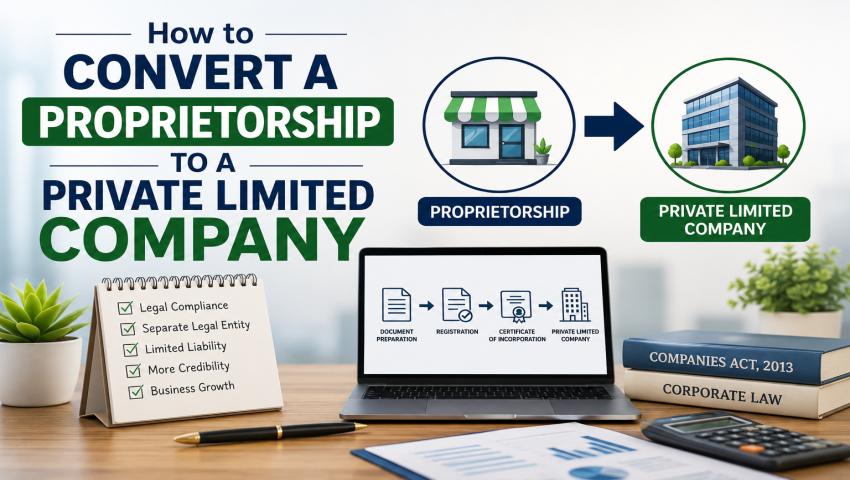
How to Convert a Proprietorship to a Private Limited Company?
Many businessmen in India start their journey as sole proprietors. It is easy to start, less paperwork, and you are your own boss. But after some time, when your business starts growing, you feel that something is missing.
Clients are asking for your company registration number. Banks are not giving loans easily. Investors are saying “come back when you have a Pvt Ltd company.” Sound familiar?
This is the right time to convert your proprietorship into a Private Limited Company.
At Startup Portal, our experts Nikhil Rajarshi and Govind S. Jethani have more than 8+ years of experience in helping business owners with this exact process. As a leading name in online company registration in Pune, we have helped hundreds of entrepreneurs make this shift — smoothly and without any business interruption.
In this blog, we will explain everything in simple language — why to convert, what documents are needed, step-by-step process, and what happens after conversion.
What is a Sole Proprietorship?
A sole proprietorship is a business run by one single person. There is no difference between you and your business in the eyes of law. Whatever profit comes — it is yours. But whatever loss or legal problem comes — that is also fully yours.
This is fine when you are starting small. But as business grows, this structure creates problems:
- If your business gets into debt, your personal property (house, car, savings) can also be at risk
- You cannot get investment from angel investors or venture capitalists
- Big companies and government tenders often do not work with proprietorships
- If something happens to you, the business also closes — there is no continuity
- You cannot give ESOPs to attract good employees
What is a Private Limited Company?
A Private Limited Company (Pvt Ltd) is a registered company that is treated as a separate legal entity — meaning the company and the owner are two different things in the eyes of law.
Here is a simple comparison:
Why Should You Convert?
Let us understand this with a simple example.
Ramesh runs a software services firm in Pune as a sole proprietor. His business is doing well — ₹50 lakh turnover per year. Now a big IT company wants to give him a ₹2 crore project. But they say — “We only work with registered Pvt Ltd companies.”
Ramesh also wants to hire two senior developers but they want ESOPs. And his CA is telling him that as a Pvt Ltd, he will save more tax also.
This is exactly why conversion makes sense. Here are the main benefits:
- Limited Liability Protection : Your personal assets are safe. If the company faces any loss or legal dispute, only the company’s assets are at risk — not your personal savings or property.
- Better Access to Funds : Banks give loans more easily to Pvt Ltd companies. Angel investors and VCs only invest in companies — not in proprietorships.
- More Credibility : When you have a registered company with CIN number, clients and vendors take you more seriously. Government tenders also become accessible.
- Tax Benefits : Private Limited Companies pay tax on profit, not on total income. There are many deductions available that are not available to sole proprietors.
- Business Continuity : A Pvt Ltd company runs forever — even if the owner retires or passes away. The business does not stop.
Legal Framework — Which Laws Apply?
This conversion is governed by two main laws in India:
- Companies Act, 2013 — This covers the process of incorporation and corporate governance
- Income Tax Act, 1961 — This covers the tax side of the conversion, including capital gains exemption under Section 47(xiv)
The entire process is handled through the MCA (Ministry of Corporate Affairs) portal — and today most of it can be done fully online.
What Are the Requirements Before Starting?
Before you apply for conversion, make sure these things are in place:
- Minimum 2 Directors and 2 Shareholders : You need at least 2 directors. You can be one director, and your spouse, friend, or relative can be the second. Directors and shareholders can be the same people.
- Director Identification Number (DIN) : Every director must have a DIN — a unique number given by MCA to identify directors of companies.
- Digital Signature Certificate (DSC) : All directors need a DSC to sign forms electronically on the MCA portal.
- 50% Voting Rights for 5 Years : As the proprietor, you must hold at least 50% voting rights in the new company. And you must keep this for at least 5 years after conversion.
- Minimum Share Capital of ₹1,00,000 : The new company must have a minimum authorised share capital of ₹1 lakh.
Documents You Will Need:
Keep these documents ready:
- PAN card and Aadhaar card of all directors and shareholders
- Passport-size photographs
- Address proof of directors (electricity bill, bank statement, or Aadhaar)
- Proof of registered office (electricity bill + NOC from owner, or rent agreement)
- GST certificate of your existing proprietorship
- Bank statements of the proprietorship
- Trade licences, vendor contracts, and any other existing registrations
How to Convert a Proprietorship to a Private Limited Company
- Get Digital Signature Certificate (DSC): The first step is to get DSC for all proposed directors. This is like your digital ID for signing government forms online. It is ready in 1–2 working days.
- Apply for DIN (Director Identification Number): Each director applies for DIN on the MCA portal. If any director already has a DIN from a previous company, the same can be used.
- Reserve Company Name (RUN Form): You apply for your company name through the RUN form on MCA portal. As per MCA guidelines the name must be unique — it should not match any existing company or trademark. Always keep 2–3 name options ready.
- Draft MOA and AOA: Memorandum of Association (MOA) and Articles of Association (AOA) are the most important documents of your company. The MOA must clearly mention that the company’s purpose includes taking over the existing sole proprietorship business. This clause is compulsory — without it, the conversion is not valid.
- Sign the Takeover Agreement: A formal agreement is signed between you (as the sole proprietor) and the new company. This agreement says that all assets, liabilities, and goodwill of the old proprietorship are now transferred to the new company.
- File SPICe+ Form on MCA Portal: SPICe+ is the main incorporation form filed on the MCA portal. It covers company details, directors, shareholders, and registered office. Along with this, the AGILE-PRO-S form allows you to simultaneously apply for GST registration, EPFO, ESIC, and open a company bank account — all in one go.
- Get Certificate of Incorporation (COI): Once MCA approves everything, you receive the Certificate of Incorporation along with your company’s CIN (Corporate Identity Number). This is the official proof that your Private Limited Company now exists.
- Transfer All Assets and Liabilities: Now all assets (machines, stock, money receivable, goodwill) and liabilities (loans, money payable) of the proprietorship are formally transferred to the new company as per the takeover agreement.
- Open New Company Bank Account: Close the old bank account in the proprietorship’s name. Open a fresh current account in the name of your new Private Limited Company.
- Update All Registrations: Update your GST registration, Udyam/MSME certificate, trade licences, vendor agreements, and any other government approvals with the new company’s name and details.
What About Tax? Big Benefit Under Section 47(xiv)
Many business owners worry — “If I transfer all assets to the new company, will I have to pay capital gains tax?”
Good news — No! Under Section 47(xiv) of the Income Tax Act, this transfer is fully exempt from capital gains tax, as long as you follow these conditions:
- All assets and liabilities of the proprietorship are transferred to the company
- You hold at least 50% voting rights in the company
- You keep this shareholding for minimum 5 years
- You do not take any extra benefit beyond the shares given to you
This makes conversion very tax-friendly when done properly.
Common Problems and How to Avoid Them?
- Name Getting Rejected MCA rejects names that are too common or similar to existing companies. Always keep 2–3 name options ready and avoid generic words.
- Wrong MOA/AOA If the takeover clause of MOA is missing, your application will be rejected. Always take help from a professional for drafting these documents.
- GST Transfer Issue GST registration does not transfer automatically. You need to apply for new GST registration under the company and cancel the old one.
- Asset Valuation If your proprietorship has big assets, get a proper valuation done before transfer. This avoids disputes later.
After Conversion — What Are Your Responsibilities?
Once your Pvt Ltd company is formed, there are some yearly compliance requirements you must follow:
- ROC Annual Return — file financial statements with MCA every year
- Statutory Audit — get your accounts audited by a CA every year
- Board Meetings — hold at least 4 board meetings per year with proper minutes
- Income Tax Return — file ITR for the company separately
- GST Returns — if your company is GST registered
Don’t worry — at Startup Portal, we handle all of this for you as well.
Why Choose Startup Portal for Converting a Proprietorship to a Private Limited Company?
If you are in Pune, Pimpri-Chinchwad, Nashik, or anywhere in Maharashtra — Startup Portal Business services is your trusted partner for online company registration in Pune and full business compliance.
Here is why so many entrepreneurs trust us:
- 8+ Years of Experience — Nikhil Rajarshi and Govind S. Jethani have personally helped hundreds of proprietors convert to Pvt Ltd companies
- Full Support — from DSC to Certificate of Incorporation, we manage everything
- Clear Pricing — no hidden charges, no surprises
- Fast Process — most conversions done in 15–20 working days
- After Registration Support — GST filing, ROC compliance, income tax, and more
Conclusion:
Converting your proprietorship into a Private Limited Company is one of the smartest decisions you can take for your business. It protects you personally, opens doors to funding, builds your credibility, and gives your business a strong foundation for the future.
Still have questions? Not sure where to start? Just book an appointment with our experts Nikhil Rajarshi or Govind S. Jethani — they will understand your business situation and guide you step by step.
📞 Call / WhatsApp: +91 8975400253 / +91 7249645760
📧 Email: enquiry@startupportal.in