
- July 10, 2026
- Startup Portal
- 0 Comments
- Blogs
Opening a Clinic? Registrations Every Doctor Needs Before Starting Practice
Starting your own clinic is a big step in any doctor’s career. After years of study and training, you finally get to practice on your own terms. But before you put up that “Open” board, there is some paperwork you need to take care of. Many doctors get confused about which registrations and licenses are actually needed.
At Startup Portal Business Service, we help doctors and healthcare professionals with company registration services in Pune and clinic-related compliance work. Our experts, Nikhil Rajarshi and Govind S. Jethani, bring over 8+ years of experience helping people navigate the registration process smoothly. In this blog, we will walk you through every registration you need before opening a clinic, in simple words.
Why Legal Compliance Matters Before Starting Practice?
Before we get into the list, let us understand why this matters. Running a clinic without proper registrations can lead to heavy fines, legal notices, or even forced closure. Patients also trust clinics that follow proper rules. So, getting your paperwork right from day one saves you from headaches later and builds trust with your patients.
If you are also planning to opening a clinic as a private limited company or LLP, you may want to look into online company registration in Pune to keep your business structure clean and organised from the start.
1. Medical Council Registration:
This is the most basic and most important registration for any doctor. State Medical Council Registration
Every doctor must be registered with their respective State Medical Council. This registration proves that you are a registered medical practitioner, meaning you have completed your medical education and are legally allowed to practice medicine in that state.
2. NMC (National Medical Commission) Registration:
The National Medical Commission, which replaced the Medical Council of India, maintains a national register of all doctors. If you plan to practice in multiple states or want your credentials recognised across India, having your details updated with the NMC is important.
Without these registrations, you simply cannot call yourself a “registered medical practitioner,” and practicing without this status is illegal.
3. Clinic or Establishment Registration:
Once your personal registration is sorted, your clinic as a business entity also needs registration.
- Clinical Establishment Act Registration: Many states have adopted the Clinical Establishment Act, which requires all clinics, hospitals, and diagnostic centers to register with the local health authority. This registration checks that your clinic meets minimum standards for infrastructure, staff, and equipment.
- Shop and Establishment License: This is a state-specific license that almost every business, including clinics, needs. It regulates working hours, employee welfare, and other basic operational rules. You will need to apply for this through your local municipal corporation or labour department.
4. Trade License:
A trade license is issued by your local municipal corporation and gives you permission to run your clinic in that particular location. It confirms that your clinic complies with local zoning laws and health and safety standards. Without a trade license, your local authority can ask you to shut down operations.
5. GST Registration:
GST registration for clinics can be a little tricky because healthcare services are largely exempt from GST. However, there are situations where GST registration becomes necessary:
- If you sell medicines, supplements, or other products directly to patients
- If you provide certain services that do not fall under the healthcare exemption
- If your total turnover crosses the threshold limit for other taxable supplies
It is a good idea to consult with company registration consultants in Pune to understand whether GST applies to your specific clinic setup, since rules can vary based on services offered.
6. PAN, TAN, and Bank Account:
Even as an individual doctor, having a separate PAN for your clinic (if operating as a firm or company) helps keep your finances organised. A TAN (Tax Deduction and Collection Account Number) is needed if you plan to deduct TDS on salaries paid to staff. Along with this, opening a separate current bank account for your clinic makes accounting, tax filing, and tracking income much easier.
7. Biomedical Waste Management Authorization:
This is one registration that many new clinic owners overlook, but it is mandatory. Under the Bio-Medical Waste Management Rules, every clinic that generates medical waste, such as used syringes, bandages, or expired medicines, must get authorization from the State Pollution Control Board. You will also need to tie up with an authorized biomedical waste disposal agency to collect and dispose of this waste safely.
8. Pollution Control Board Consent:
Apart from biomedical waste authorization, depending on the size and nature of your clinic, you may also need a Consent to Establish and Consent to Operate from the State Pollution Control Board. This is especially relevant if your clinic has any diagnostic equipment, lab facilities, or generates effluents that need monitoring.
9. Fire Safety NOC:
A Fire No Objection Certificate (NOC) is required based on the size of your premises and the nature of your building. Fire safety NOC ensures your clinic has proper fire extinguishers, exit routes, and safety measures in place. This is particularly important if your clinic is located in a multi-story building or has multiple rooms with electrical equipment.
10. Pharmacy License:
If you plan to dispense medicines directly from your clinic, rather than just prescribing them, you will need a pharmacy license under the Drugs and Cosmetics Act. This involves having a registered pharmacist on staff and maintaining proper storage conditions for medicines.
11. X-Ray or Radiology License:
If your clinic has X-ray machines, CT scanners, or any equipment that uses radiation, you must get registration from the Atomic Energy Regulatory Board (AERB). This registration ensures that radiation safety standards are followed to protect both patients and staff.
12. Professional Tax Registration:
Professional tax is a state-level tax that applies to professionals, including doctors, and to employers who have staff on their payroll. Registration requirements and rates vary from state to state, so it is best to check with local authorities or a consultant familiar with your state’s rules.
13. Employee-Related Registrations:
If you are hiring staff such as nurses, receptionists, or assistants, you may need additional registrations depending on the number of employees:
- ESI (Employee State Insurance) registration, applicable once you cross a certain number of employees
- PF (Provident Fund) registration, also based on employee count
- Compliance under the Shops and Establishment Act for working hours, leave policies, and employee welfare
These registrations protect both you as an employer and your staff, and help you avoid labour law issues down the line.
14. Signage License:
This might seem like a small thing, but most municipal corporations require a separate license or permission to display a signboard or name board outside your clinic. This typically involves a small fee and is part of advertising regulations under local body laws.
15. Insurance:
While not strictly a “registration,” getting professional indemnity insurance or medical malpractice insurance is highly recommended. This protects you financially in case a patient files a complaint or lawsuit against you for any treatment-related issue. Many doctors skip this thinking it is optional, but it can save you from major financial loss in case of legal disputes.
Final Checklist Before You Open Your Clinic:
Here’s a quick summary of what you need:
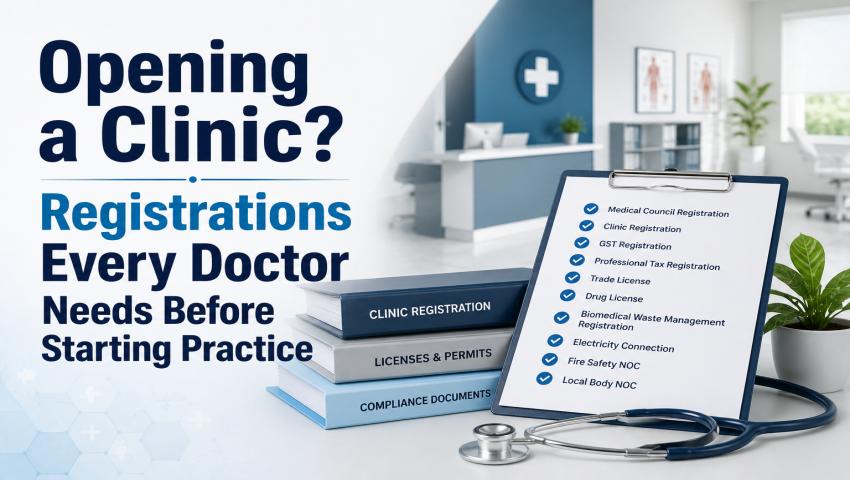
- State Medical Council and NMC registration
- Clinical Establishment Act registration
- Shop and Establishment license
- Trade license from municipal corporation
- GST registration, if applicable
- PAN, TAN, and bank account
- Biomedical waste management authorization
- Pollution Control Board consent
- Fire safety NOC
- Pharmacy license, if dispensing medicines
- X-ray or radiology license, if applicable
- Professional tax registration
- Employee-related registrations (ESI, PF)
- Signage license
- Professional indemnity insurance
Conclusion:
Opening a clinic involves more than just medical expertise. It requires careful planning around legal and regulatory compliance too. While the list above might look long, most of these registrations are one-time processes that, once done, let you focus completely on patient care.
If all this paperwork feels overwhelming, you do not have to handle it alone. At Startup Portal Business Services, our team, including experts Nikhil Rajarshi and Govind S. Jethani with their 8+ years of experience, can guide you through every step. Whether you need help with company registration Services in Pune, finding the right company registration office in Pune, or simply understanding which licenses apply to your clinic, we are here to help.
Reach out to Startup portal Business Service today and take the first step towards a smooth, hassle-free clinic opening.